Matchroom’s 2026 UK Open Nine Ball Championship recently took place in Essex's Brentwood centre. Here, some of the finest displays of 9 ball pool was showcased from the finest players across the globe, with Germany's Joshua "The Killer" Filler taking the crown in dominant fashion; but what actually is 9 Ball? How is American Pool different to English Pool? Whilst adjacent, both games have many distinct characteristics that provide different, exciting ways to play and test your skills!
Tables
One of the biggest differences is the table size. English tables are much smaller (6ftx3ft or 7ftx4ft) than American tables (9ft tournament standard), leading English pool to focus more on smaller, touch-based shots and more precise positional play where American pool provides more space to move the cue ball in.
The pockets are also cut differently - English pool adopts rounded Snooker-style pockets, whereas American Pool uses sharper, angular pockets. This makes shots down the cushion easier but acute angles less forgiving, especially into the middle pockets.
English pool uses a napped cloth that runs from the baulk cushion to the bottom cushion; this is because it slows the cue ball down to allow for tactical, precise gameplay.

American Pool uses a smooth, napless worsted wool cloth designed to play quickly so that the bigger and heavier balls can travel further.

Cues and Balls
You cant have pool without balls, and this is another key area of difference. English Pool uses red and yellow balls with a 2” diameter, whereas American Pool uses spots and stripes with a 2 ¼“ diameter. English Pool balls are most noted for featuring a smaller, lighter cue ball (1 7/8” diameter), making screw shots easier but topspin more difficult to control as the cue ball naturally bounces after contacting the object ball, changing its line.

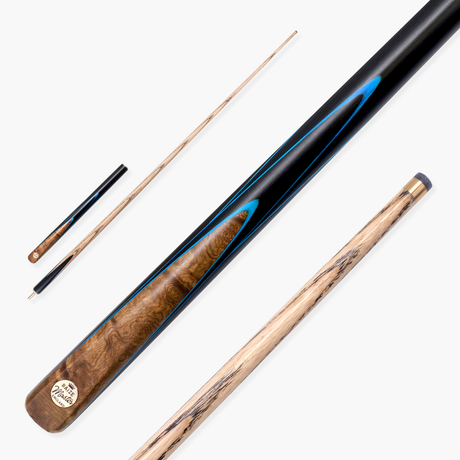
Cue sizes reflect this too. English Pool cues use 8mm-9.5mm tips, while American Pool cues use 11mm-13mm tips to propel the heavier balls safely. English cues are predominantly Ash wood, whereas American cues are usually Maple, with carbon fibre becoming increasingly popular due to its shockproof qualities and ability to impart spin with less effort. American cues are also commonly 2-piece centre-jointed cues with interchangeable shafts for customization, something uncommon in English pool.

Rules/Disciplines
Both games share a love for 8 ball, arguably the world’s most popular discipline. English Pool is purely an 8 ball game, with variations in how it’s played coming through different rulesets rather than different disciplines themselves. These can include International rules, World rules, and Blackball rules
American Pool has a history of several disciplines, especially as a result of using spots and stripes:
• 9-Ball: Balls are potted in numerical order from 1-9, with the player potting the 9 winning. Potting the 9 ball after contacting the lowest numbered ball can win frames early.
• 10-Ball: Like 9-Ball, but all pots(and in some variations, safety shots) must be called and potting the 10 early does not win the frame.
• Banks: Every pot must be a called bank shot. First player to 8 balls wins the frame.
• Straight Pool/14.1 Continuous: Pot as many balls as possible in any order, scoring one point per legal called pot. Once 14 balls are potted, the balls are re-racked and play continues
• One Pocket: A tactical game where each player is assigned one bottom pocket, with the first to pot 8 balls in their pocket winning.
Some players use 2” spots and stripes on English pool tables for the versatility of being able to enjoy all these games alongside 8 Ball, whilst also fitting into a smaller space.
Whether you prefer the tactical precision of English Pool or the fast-paced, attacking nature of its cross-Atlantic cousin, both games and their rulesets/disciplines remain as fun and as addictive as each other despite their differences. Truly there is something is something for everyone in the world of Pool, and at Cue+Case we are well-equipped to cater to for all your needs regardless of the game you play!